





At the beginning of the reign of Napoleon III and until 1870, it was especially the bourgeoisie who liked to drink this drink with its original taste and asserting character. An expensive drink, it was essentially served as an aperitif in the great Parisian dinners or in fashionable bourgeois cafés.
Distilled up to 70°, absinthe was strongly present in all intellectual and artistic meetings in Paris of this era. Painters, writers and artists looked for inspiration by sipping absinthe without moderation.
In the Montmartre cafés, at the Martyrs brasserie, at Rat Mort or Chat Noir, this modern exiting drink confused and charmed the impressionists, Degas, Manet, Van Gogh and especially Gaugin. The latter wrote: “I am sitting at my door, smoking a cigarette and sipping my absinthe, and I appreciate each day without worrying about the rest of the world”. All the painters dedicated one or more paintings to him.
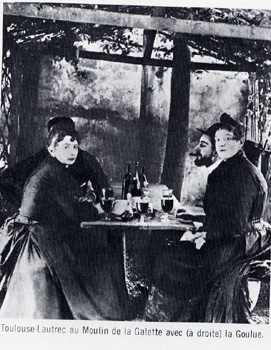
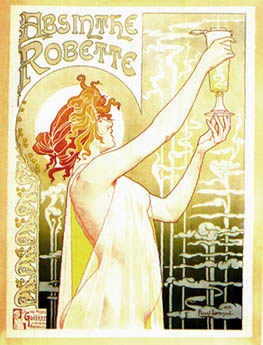 The film Moulin Rouge with Nicole Kidman is not far from the truth. Toulouse-Lautrec at Montmartre make served in 1889 a cocktail which made the girls blush, a cunning mixture and explosive with absinthe, mandarin, fine red wine and champagne.
Absinthe became equally the Muse of the green-eyed writers such as Oscar Wilde, Rimbaud, Baudelaire, Joyce, Hemingway, Edgar Poe.
“Absinthe makes you forget, but makes you pay in migraines. The first glass shows you things as you want to see them, the second shows you things as they are not; after the third, you see them as they really are.” describes Oscar Wilde who called absinthe the green fairy.
With the development of cafés, bistrots and cabarets, absinthe quickly became widespread, and in 1880 the national drink when the price of absinthe became more expensive than wine.
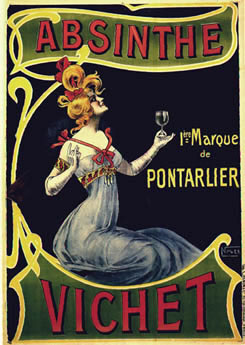 But, it is said that absinthe, because of the thuyone, warms the senses and provokes crises of delirium. Absinthe was thus very quickly ccused of being the main cause of alcoholism of the working class at the end of this 19th century. Ever since then, the sale and manufacture of this drink was banned in 1915.
Accused of being the origin of delirium crises, Absinthe was finally banned in 1915 with the war. It was only 100 years later that his sale was once again authorized.
